The Longest-Flight Quadcopter of 2026: How Endurance Drone Technology Is Breaking New Ground
For years, battery-powered quadcopters have been constrained by a simple problem: four motors continuously consume significant amounts of energy just to keep the aircraft airborne.
When we published “Longest Flight Time Quadcopter Drones” article in 2023, the endurance landscape looked very different. Hybrid drones dominated the top of the list, with systems such as the HYBRiX 2.0 reporting flight times of more than 10 hours, while battery-powered platforms such as the DJI Matrice 350 RTK offered up to 55 minutes of flight time. In 2026, however, several new endurance milestones are showing how quickly that limitation is being challenged.
As of August 2026, the official Guinness World Record for the longest-duration flight of an electrically powered multirotor drone weighing 5–20 kg is 4 hours, 21 minutes and 39 seconds. The record was achieved by South African engineer Luke Bell in Cape Town on June 21, 2026.
In July 2025, SiFly Aviation's Q12 achieved 3 hours, 11 minutes and 54 seconds in California. Guinness classified the achievement as the longest flight of an electrically powered prototype multirotor/drone weighing between 5 and 20 kilograms. Bell's 2026 flight extended that benchmark by more than an hour.
That is an extraordinary improvement for an electric multirotor because endurance is fundamentally an efficiency problem. Every additional gram requires additional lift, while every additional minute requires the propulsion system to operate efficiently for longer.
But the biggest question is no longer simply:
“Which drone can fly the longest?”
For many professional applications, a more important question is:
“How can a drone remain airborne for as long as the mission requires?”
That is where tethered drone technology changes the equation.
The Alternative: Don't Carry All the Energy
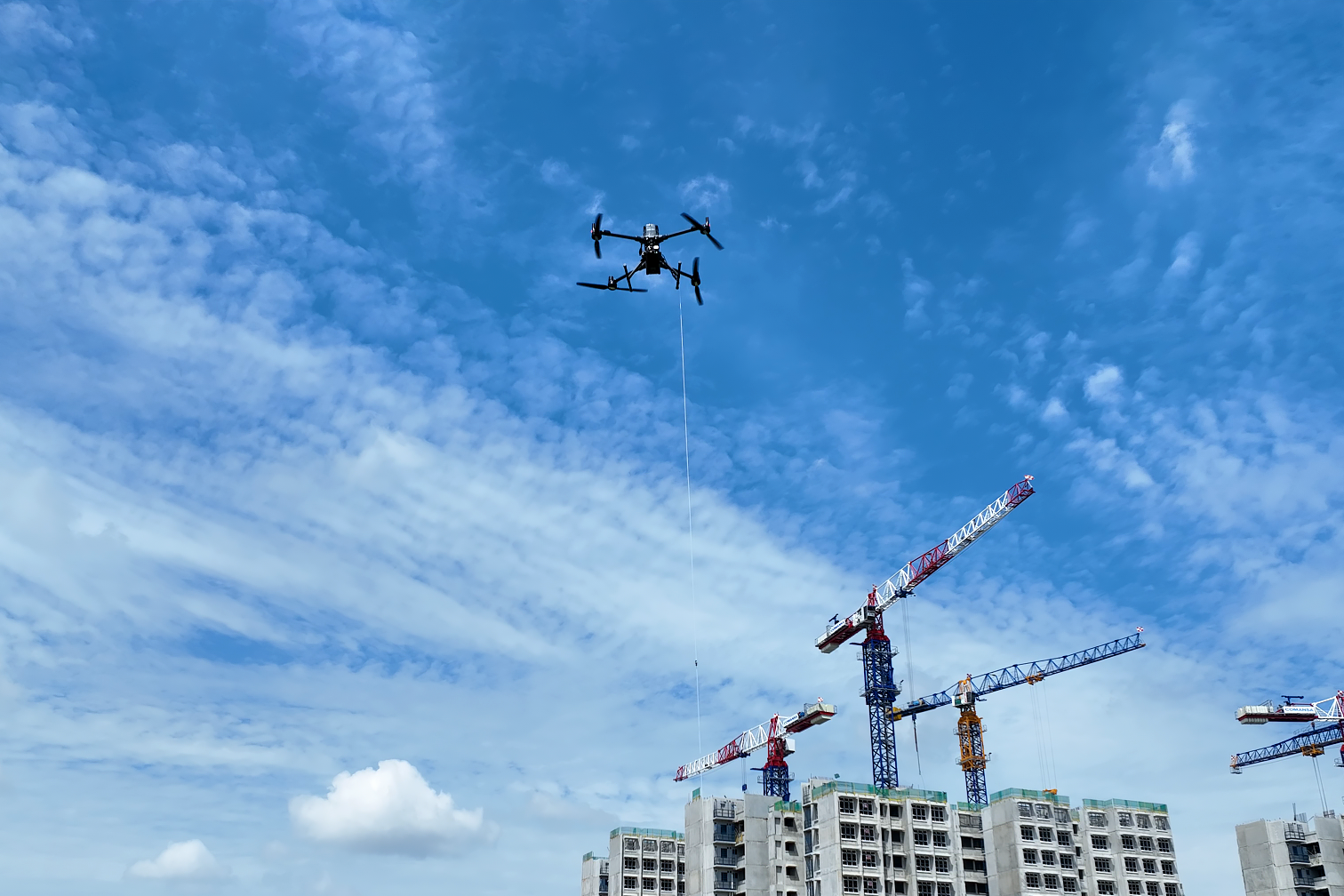
This is where tethered drones take a fundamentally different approach. Instead of putting all the energy required for a long mission inside the aircraft, a tethered drone receives power from the ground. The drone is physically connected to a ground station through a tether that provides electrical power while the aircraft is airborne.
The result is a simple but powerful change: The drone no longer has to rely exclusively on the energy stored in its onboard batteries. This is the principle behind V-Line Pro, Volarious' tethered drone system.
V-Line Pro has been tested with the DJI M30T for 24 hours of continuous flight, demonstrating the system's ability to support prolonged aerial monitoring without the conventional battery-swap cycle.